


Whose Land Whose Promise - What Christians Are Not Being Told About Israel And The Palestinians
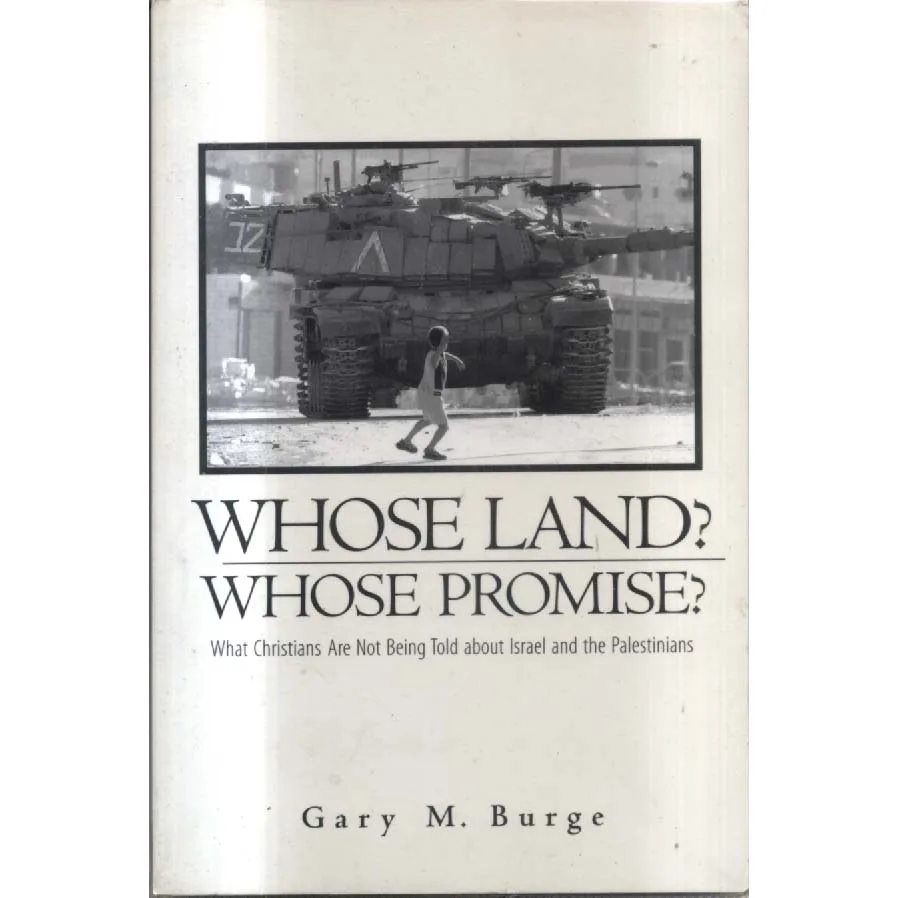
Publisher: Paternoster Press
Format: Paperback
ISBN: 0829815457
Whose Land? Whose Promise? enters the theological and political dispute surrounding Israel and Palestine with the modest proposal that Christians might read the whole Bible before using selected verses as title deeds. Gary M. Burge, a New Testament scholar and evangelical Christian, examines the widespread belief that the modern State of Israel represents the direct fulfilment of biblical prophecy and therefore merits unconditional Christian support.
Burge begins with the biblical promises of land made to Abraham and his descendants. He asks who owns the land, what conditions accompanied Israel’s possession of it and whether an ancient divine promise can be transferred without qualification into modern political policy. These are straightforward questions in much the same way that dismantling a live artillery shell is a straightforward mechanical procedure.
In the Old Testament, Burge emphasises that the land ultimately belongs to God, not permanently to any human nation. Israel’s right to inhabit it was connected to covenant, justice and obedience, including the fair treatment of foreigners living among them. The prophets repeatedly warned that religious identity did not provide immunity from moral judgement—an inconvenient scriptural detail whenever divine favour is being presented as a lifetime diplomatic exemption.
Burge then turns to the New Testament and argues that the promises concerning land are transformed through Jesus. In his reading, membership in God’s people is no longer determined by ethnicity or residence within a particular territory, while inheritance expands beyond one strip of geography to embrace the world. The Church does not receive a replacement property deed to Jerusalem; rather, the entire idea of sacred possession is reworked around Christ. Theology therefore becomes less useful to anyone hoping for a simple map with God’s preferred border marked in permanent ink.
A major target of the book is Christian Zionism, particularly within American evangelicalism. Burge challenges systems of end-times prophecy which interpret contemporary events as stages in a divinely scheduled drama. He argues that such schemes can turn Jewish and Palestinian lives into supporting material for someone else’s apocalypse, while ethical questions about occupation, displacement and human rights are postponed until after the prophetic charts have been satisfactorily aligned.
The book also introduces readers to Palestinian Christians, whose existence is often overlooked in Western Christian discussions of the region. These communities—Orthodox, Catholic, Anglican, Lutheran and evangelical—complicate the popular picture of a conflict neatly divided between Jews and Muslims. Palestinian Christians have the peculiar experience of hearing fellow Christians celebrate prophetic developments which may involve the loss of their own homes, a situation unlikely to be improved by receiving another illustrated lecture on the Book of Revelation.
Burge draws upon his travels, personal relationships and encounters with both Israelis and Palestinians. He does not deny Jewish history, suffering or attachment to the land, and he describes Jewish people as retaining a unique and honoured place within God’s purposes. His argument is instead that biblical covenant cannot be used to excuse injustice and that the actions of a modern nation-state must be assessed by the same moral standards applied to everyone else.
This is consequently a firmly argued and controversial book, not an attempt at perfectly neutral political cartography. Burge’s biblical interpretation and historical claims have attracted substantial criticism, especially from defenders of Israel and Christian Zionism, who dispute both his theology and elements of his account. Readers are therefore invited to engage with a particular evangelical critique rather than mistake the subtitle for a declaration that every other Christian has been deliberately hiding the minutes.
Published in 2003, Whose Land? Whose Promise? combines biblical study, political commentary, personal testimony and an appeal for Christian responsibility. It asks whether loyalty to scripture requires automatic support for Israel, or whether scripture instead demands justice for Jews and Palestinians alike. This does not produce a slogan suitable for a bumper sticker, but the Middle East has already endured a generous supply of those.
This Paternoster Press edition is in Very Good condition—a well-preserved copy of a book dealing with a subject whose arguments have experienced rather more wear. A thought-provoking choice for readers interested in Christianity, Israel and Palestine, biblical interpretation and what happens when ancient promise, modern nationalism and end-times theology are all asked to share the same contested piece of ground.
Keep browsing: See more Politics books Other books by Gary M Burge
